
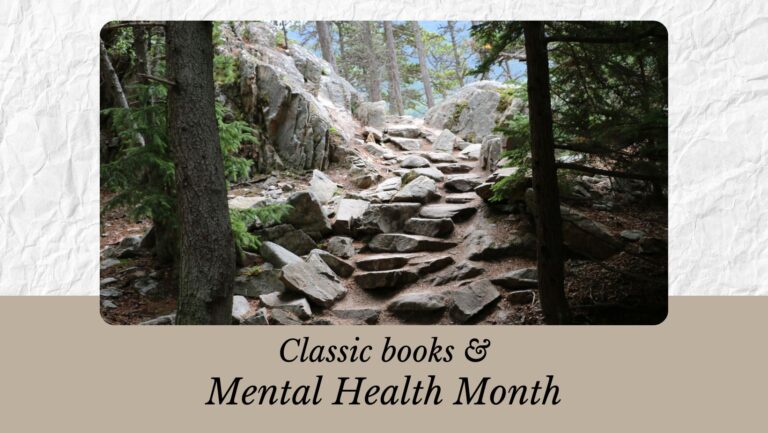
“A sad soul can kill quicker than a germ.”
John Steinbeck, on his mood swings and frequent bouts of depression/mental illness
Since 2020, Smidgen Press has been breathing new life into old stories. And almost since the beginning, we have diligently researched the writing lives of each of the authors we have republished (and even other classic authors you, dear reader, may want stories from; have a book suggestion? Please, submit it here).
Perhaps it should not surprise us the many commonalities we discover in the lives of these creative genuises, looking at classic books and mental health. These individuals displayed things like wild imaginations, a hunger to see change in the real world, and, sadly, chronic health conditions that plagued their minds and bodies.
What can we learn from those that withstood such trials and turned around to create mesmerizing tales to entertain and enlighten us? Could we learn to face our own obstacles by observing these literary giants?
As we here in the US observe Mental Health Month each May, we want to applaud those who, despite their many physical and mental obstacles, have brought delight into our lives in the written word and set examples (whether they meant to or not) of how we can face our own struggles with grit and determination, creating something beautiful and leaving a lasting legacy. We also want to recognize that some of these examples are cautionary tales, and now there is help available through religious institutions, modern science, and other organizations. Please seek help if you or a loved one is in need of it. There is hope.
Potential triggers: depression, mentions (without details) of individuals who took their own lives, or attempted to do so.
Which authors of classic books struggled with mental illness?
As noted in a previous blog, L.M. Montgomery of Anne of Green Gables fame personally struggled with chronic migraines and mental illness. Maud fought against the darkness and lived an astounding literary life. Despite, or perhaps in part due to, this inner war, she brought us vibrant, hopeful characters. But who else suffered similar hardships that we can learn from?
When we started down this path, we didn’t have to dig very deep to discover there are a number of ties between authors of what we consider classic books and mental health struggles.
Edgar Allen Poe
Renowned American poet and author Edgar Allen Poe suffered from possible bipolar disorder. His frequent bouts of depression, deep grief over personal loss, and his struggle with poverty (despite the fame garnered by his writing) all greatly impacted his work. We know that he did attempt suicide a year before he died, and many are unsure as to whether he ultimately died by his own hand. But these many battles led to vivid, often wild stories and poems that have enriched literature for generations of readers.
Charlotte Brontë
English poet Charlotte Brontë, famously the author of Jane Eyre and other critically acclaimed works, struggled with horrible headaches and also what literary historians believe was major depressive disorder throughout her life. You don’t have to be a literary specialist to trace signs of depression in her melancholy characters. Despite the depression and headaches, or perhaps due in part to it, she went on to create novels that are still studied and beloved by millions of readers.

Joseph Conrad
Joseph Conrad, who wrote many novels and short stories including Heart of Darkness, suffered from gout, but it was his battle with deep depression over his debt that likely led him to try to take his own life. His depression was so prevalent that those who knew him stated that it superseded his many other illnesses. But despite—or perhaps because of?—this darkness, he continued to write, having a character say, in Chapter 20 of his book Lord Jim, “The question is not how to get cured, but how to live.”
F. Scott Fitzgerald
F. Scott Fitzgerald suffered from depression, anxiety, and severe alcoholism, but can we imagine a literary world without his works? His trials with mental health were often at odds with his ability to write. Oh, but when he could—! Some critics credit his literary classic The Great Gatsby as THE great American novel, despite the fact that many readers are polarized by either hate or love after reading it. Aren’t we glad that, despite the difficulty, he wrote it?
Ernest Hemingway
Ernest Hemingway, arguably one of the greatest authors to have ever lived, led a complicated life of vivacious adventure but carried deep paranoid depression and PTSD after his service in World War I, having been severely injured at the age of 18. Modern research on post-concussion syndrome in professional athletes may explain some of Hemingway’s recurring struggles with mental health and his suicidal tendencies, particularly since he notably sustained at least nine concussions over the course of his life. But could we divorce the great writer from his mental health issues? Did one lead to the other?
Other connections of classic books and mental health
In addition to these names mentioned, there are so many others, authors like Ezra Pound, John Steinbeck, Franz Kafka, Sylvia Plath.
In fact, the more we dug, a surprising question kept coming up…
Can mental illness trigger enhanced creativity?
From the evidence patterned through history, many writers have been greatly impacted by their mental health but have also produced significant works, even had prolific writing careers. This has led researchers to investigate whether mental health conditions might be connected to great creativity. One psychologist, James C. Kaufman, even went so far as to coin the phrase, the “Sylvia Plath Effect,” though he specifically noted that poets were more likely to suffer depression than other writers.
But honestly, can you imagine a mentally healthy Edgar Allen Poe being able to write “The Tell-tale Heart” or “The Raven”? Sylvia Plath herself drew heavily on her own experiences to write “Mad Girl’s Love Song” and the (possibly autobiographical) epic tale of the “crack-up” of the fictitious Esther Greenwood in Plath’s only novel, The Bell Jar. Plath was even penning the sequel to The Bell Jar when she succumbed to her illness and took her own life.
The tension
Poe and Plath represent the barest fraction of the stories available. It is not difficult to assume a connection between the genius of these poems and classic books and mental health issues.
To be clear: we care deeply about the lives of authors, humans, past and present. We never want to be heartless reporters as we consider the psychology of how past authors wrote and how such things may impact our lives today.
And perhaps there’s a reason Mental Health Month in the United States is observed in May, when the whole country should be well into shaking off the cloak of winter and the larger population who battles winter Seasonal Affective Disorder [SAD] should be coming up for air. But we mustn’t forget, as we have compassion on one another, that there are both winter- and summer-pattern SAD, too. Though the summer-sensitive variety is less common, if you see someone struggling and it seems to be persistently seasonal, it’s worth exploring these connections and supporting one another.
There is a sad number of authors we read about who did take their lives. But there are many who did not. During life, these writers used their imaginations and their command of language to explore and often to fight against the darkness. Though many have sad endings, we can celebrate what they were able to accomplish, despite their overwhelming odds.
Perhaps, rather than categorizing past lives only as either tragedy or triumph, we can find hope in what they have done and have real conversations today to break down stigmas around mental health challenges humanity faces today.
Our final note: You don’t need to struggle alone.
Depression can feel like such a poison. Anxiety may seem like it runs your life. Other severe imbalances (mental, physical, emotional … so many on this broken world) can tempt us to believe there’s no hope.
If you, or someone you know, is depressed and feeling stuck, or you’re contemplating self-harm or suicide, you don’t have to fight these things alone. Our hope is that you have a supportive local community, be that religious, medical, psychological, or otherwise. And of those categories, mental health issues are never only one facet of our being. We need multifaceted support.
If you don’t have anyone local, then as part of your search, you can be connected to local resources through the Substance Abuse and Mental Health Services Administration (SAMHSA) National Helpline at 1-800-662-4357. That’s a big, long name, but if you’re wondering if your situation matters enough to reach out … Yes.
Yes it does.
You matter.
For help with depression, you can text the word CONNECT to the number 741741 to chat with a human immediately.
Or text or call 988 for help with suicidal or self-harming thoughts or actions.
This post has been weeks in the making as we seek to connect with you, dear readers, and not pretend the world simply disappears because we read books (though the things we read can help or hurt). As we have been doing before we began this research and have carried through all this process … we are praying for you. And we welcome your prayers for us.

