
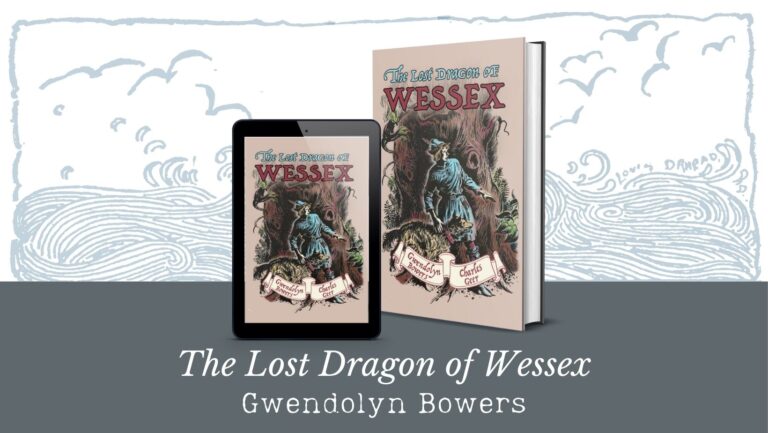
After author Gwendolyn Bowers set out to write about the adventures of a young man named Wulf in The Lost Dragon of Wessex, one might wonder if she knew she was penning one of the most brilliant examples of the “Hero’s Journey”—a common story structure involving a main character who goes on a journey, experiences challenges to overcome, and returns home transformed. This fits 13-year-old Wulf’s story perfectly … and he’s a hero we can all cheer for!
Or listen to an audio sample:
Who doesn’t need a hero?
From the time we meet Wulf living with Tostig, a gruff villager, there is mystery surrounding him and his destiny. Tostig has attached the young man’s destiny to an ancient tree that he believes the old god Woden has blessed. The old man is determined that they will wait there for the return of a stranger. But when the tree is hit by lightning, Tostig rethinks his beliefs, telling young Wulf the little that he knows of the new God that has come to replace the old one. No longer willing to let Wulf linger, he thrusts the boy forward, sending him on his way with a heavy, lumpy ring covered in canvas, and a gold coin.
Stepping into the new world, what will our young hero discover? Friends? Adventures? Opportunities to grow and learn, perhaps to become a brave warrior? A brilliant bard and harpist?
England, under the rule of King Alfred, is at odds between Saxons and Britons, even as the invading Danes try to make inroads. But what if Wulf’s destiny is meant to shine light on an ancient prophecy and herald in a new era for the kingdom?
History via lecture, or via story?
While several of our team lamented our lack of Medieval British history, this book was a good read. And when we started asking around to see who did know this era, and looking over the lecture-type histories (since we needed better accuracy for book descriptions) … Ms. Bowers proved to be quite a thorough researcher.
There are so many historical pieces from King Alfred’s
To get a feel for how and where the “northmen” – primarily Norsemen and Danes – were invading what we now call England, we appreciated this map link. And with Wikipedia now proving to be a credible site when articles are well cited, which is more fun: a Wikipedia article with a lot of the same information, or an engaging storyline with a character you can follow to learn more?
(OK. They’re both important. But we hope you have fun with this story, too.)
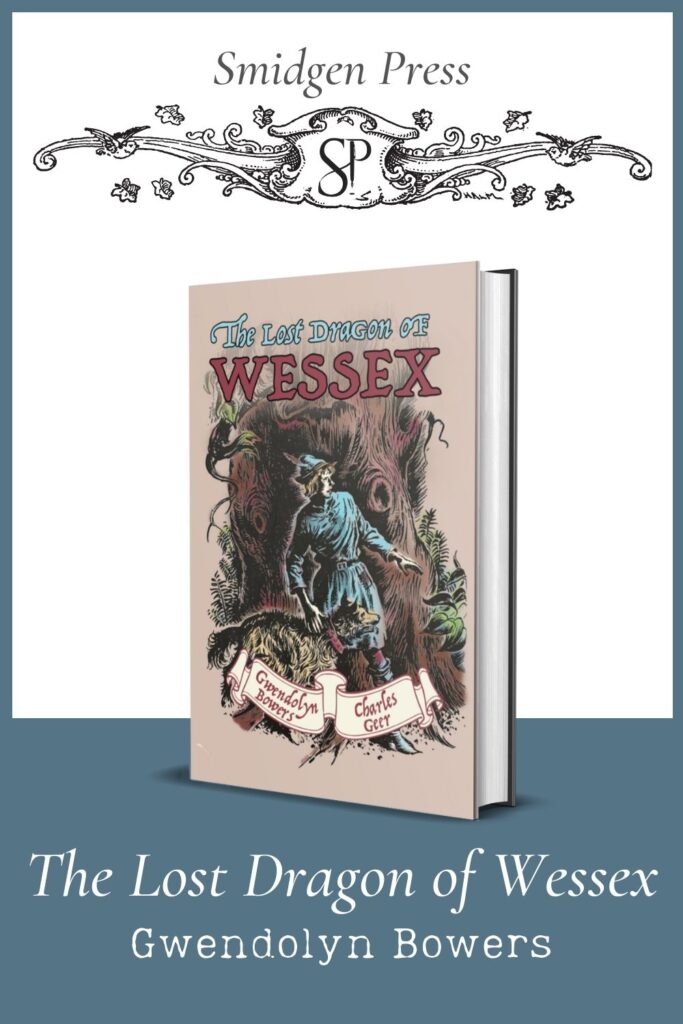
How did we choose to reprint this particular book? A reader had mentioned The Adventures of Philippe: A story of old Kebec, also by Gwendolyn Bowers, saying that they’d be interested in an ebook version.
When we realized homeschooling organization The Good and the Beautiful had reprinted Philippe, we decided to hold off and instead pursued Bowers’s medieval King Alfred the Great tale instead. When we researched, Lost Dragon had neither print nor ebook reprints, and our research proved the text and artwork to be in the public domain. So then, this became our chosen direction.
(TGTB isn’t reprinting Philippe any longer, so if you’d like to see that in the future from us, fill out our request form to let us know!)
Brief content notes
In this 1957 classic, Bowers reaches back centuries to far older language, bringing in Saxon words like “Monan-daeg” for Monday, words like “tholes” for oar pegs and “steerboard” for a rudder, and some words she clarifies immediately, like “thegn” (“thane”) for a warrior-servant and “wyrd” (“weird”) for a person’s destiny.
Most of the time, context makes it easy to understand. But there are a few words we wouldn’t want to be a complete surprise to parents, and ideas that might be brought up as potential talking points.
- Young Wulf is sent to gather “faggots [of wood] for the fire.”
- At the feast where Wulf meets the king, a servingwoman brings in a platter of “smoking joints [of meat]”
- Old religions and superstitions are mentioned as cultural background, along with the coming of Christianity to the British Isles. Besides the “one God,” the people talk of Woden and of “water demons” haunting the swamps.
- Per the Treaty of Wedmore, and as common to the time, the conquered Danish troops were made to adopt Christianity as a condition of the truce.
If you come across other points you think are worth discussing, we would enjoy connecting on Facebook or Instagram. Or you can email our team at hello@smidgenpress.com.
A favorite quote
There was one quote that was mentioned by several of our Ambassador team*, our early-access readers. So we thought we’d share it with you:
“You are young to be a warrior.” Brother Otho smiled. “But there are other ways to serve the King. I serve him with my books.”
“With books?” Wulf repeated. “How can you serve the King with books?”
“By reading them and teaching others to read,” said Otho. “The King wants learning for his people, for where there are books, men will be free.”
Gwendolyn Bowers, The Lost Dragon of Wessex (Ch. 4)
(*If you’re interested in early ebook and audiobook access with our Ambassadors, you can apply to join at SmidgenPress.com/ambassadors.)
Smidgen Press is happy to welcome The Lost Dragon of Wessex
This beautiful edition of The Lost Dragon of Wessex is brilliantly illustrated by Charles Hand Geer. Each picture is as poignant as the lyrical language Bowers uses to weave her tale.
A bonus section at the back provides some additional historical context, including two maps of the region.
Whether you chose to read it alone, aloud with your family, or even listen to it in our first audio release from Smidgen Press, we think you will be delighted.
As always, Smidgen Press has taken special care in republishing The Lost Dragon of Wessex, making it accessible to modern readers, a lovely addition to e-readers and bookshelves anywhere. Click through to our shop to find the format that most appeals to you.
Interested in more from the Press?
We’d love to have you join our newsletter which will keep you up to date on new publications. Join here and find out more.

