
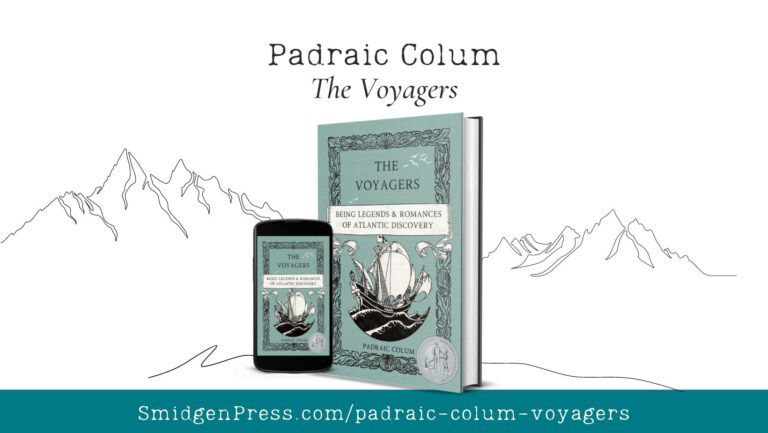
This 1926 Newbery Honor book, The Voyagers by Padraic Colum, is back in print, Newbery medal and all. See the end of this post for content considerations on this project, and visit our shop page here:
“Patrick Columb” to “Padraic Colum”
Playwright, poet, and novelist Padraic Colum, born “Patrick Columb,” began his life in Ireland. His father was the master of the Longford Union Workhouse—a facility where the poor were expected to work for their lodging—and it is here that young Patrick may well have picked up a love of stories as he grew to know the inmates. When his father lost his job, the young boy moved to be with his mother’s people. There he traveled with his uncle to fairs, meeting storytellers and ballad singers, laying further groundwork for the great literary figure he would become.
His early published poems caught the notice of literary greats like poet W.B. Yeats, publicist George William Russell, and Irish dramatist and folklorist Augusta, Lady Gregory. Now known as Padraic Colum, he became an integral member of the talent in the Irish Literary Revival, many of whose members were tied to the founding of the Abbey Theatre (later the National Theatre of Ireland). In later times, his realistic plays have been credited with being foundational in developing modern Irish theatre. At the time, though, he was only able to pursue writing full-time due to a generous five-year scholarship provided by American benefactor Thomas Hughes Kelly.
It was not until after marrying writer and literary critic Mary Maguire that doors opened for him as a writer. The couple emigrated to America where Colum began writing for children, receiving Newbery Honor medals for three of his books: The Golden Fleece and the Heroes Who Lived before Achilles (awarded 1922); The Voyagers: Being Legends and Romances of Atlantic Discovery (1926); and Big Tree of Bunlahy: Stories of My Own Countryside (1934).
Content notes | Is this book a good fit for you?
We know that each reader/purchaser takes their book content seriously, particularly if they’re planning to hand a book off to younger readers. This book has an interesting segment, for the time period, where Colum cites his sources at the end, mentioning a number of resources and historians that he consulted to pull this patchwork book together!
What it’s easy to see, from the blessing of hindsight, is that he did not have the quality of Indigenous or Native American resources that we do today.
As a result, the perspectives of Columbus and the Jamestown, Virginia, settlers are rather lopsided away from the natives already living in what came to be known as The Americas. Some readers will accept this perspective, provided the perspective is rounded out and discussed, while others will want to avoid this book.
And that’s okay.
We are built on trust around here, and a big part of that is transparency about issues in these older editions.
So at the end of The Voyagers, we have a short and sweet list of perspectives to balance where Padraic Colum was lacking. There are so many more resources available now, but among our circle of trusted readers, these stand out. If you’re interested, here are our affiliate links to these books on Amazon (we do earn a small commission from qualifying purchases, but affiliate links help us keep our site ad-free):
- Before Columbus: The Americas of 1491 (Charles C. Mann)
- Did Columbus Really Discover America? (Peter & Connie Roop)
- The True Story of Pocahontas (Dr. Linwood “Little Bear” Custalow & Angela L. Daniel “Silver Star”)
- Pocahontas (Joseph Bruchac)
Do you have any comments or book requests for us?
We take book reprint requests at smidgenpress.com/requests, and kind human contact is always welcome at hello@smidgenpress.com.

